
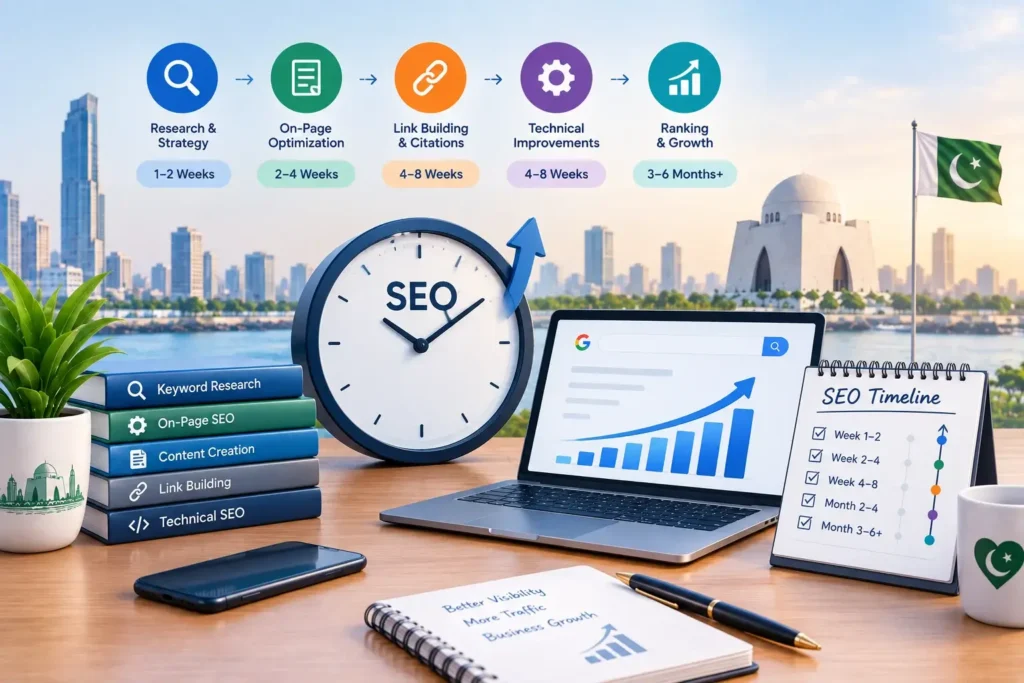
“How long until I’m on page one?” is the first question almost every business owner asks before starting SEO. It is also the hardest one to answer honestly, because the real answer depends on your website, your industry, and how much competition you’re up against.
This guide gives you a realistic, month-by-month picture instead of a vague “it depends.” We’ll also cover what actually changes the timeline, and what you should watch for in the early months, before rankings show up.
The Short, Honest Answer
For most businesses, early movement in rankings starts around 3 to 4 months. Stronger, more reliable results usually build by month 6. Brand new websites, or businesses in tough industries, often need 9 to 12 months to see real competitive rankings. These numbers come up again and again across independent SEO studies and agency data, and they match what we see with our own clients in Karachi.
If someone promises page one rankings in two or three weeks, that is a red flag, not good news. Read our guide on how to choose an SEO agency in Karachi for more warning signs like this one.
A Month-by-Month SEO Timeline
| Period | What usually happens |
|---|---|
| Month 1 to 3 | Audit, technical fixes, and on-page work are completed. Google starts crawling and indexing the changes. Rankings mostly stay flat. |
| Month 3 to 6 | Easier, long-tail searches start to move. Traffic begins rising slowly. This is when most businesses see their first real signs of progress. |
| Month 6 to 9 | Stronger keywords start ranking. Content and links built earlier start compounding. Calls and enquiries become more noticeable. |
| Month 9 to 12 | Competitive, high-value keywords become realistic. This is usually when a new website starts competing seriously with older, established ones. |
This is a general pattern, not a guarantee. Your own timeline can move faster or slower depending on the factors below.
What Makes SEO Faster or Slower
How old and trusted your website already is
A brand new domain has no history with Google yet, so it takes longer to earn trust. A website that has been live for a few years, even without much SEO work, often moves faster once real work starts.
How competitive your industry is
A local plumber competing for a few nearby suburbs moves faster than a real estate agency competing across all of Karachi. The more businesses fighting for the same words, the longer it takes to break through.
The state of your website when you start
A site with technical problems, thin content, or confusing structure needs those issues fixed before rankings can move at all. See our guide on why a website may not show on Google if you suspect this applies to you.
How much consistent work goes in each month
SEO compounds. A little work every month for a year beats a big push for one month followed by nothing. Our page on what a monthly SEO package includes shows what steady, ongoing work actually looks like.
New Website vs an Established Website
A brand new website usually needs 6 to 12 months to rank competitively, since it has no history, no links, and no trust built up yet. An established website with a working history often sees results faster, sometimes within 6 to 8 weeks, especially if the earlier SEO work was weak and there is easy room to improve.
If your site is brand new, do not be discouraged by a slower start. It is normal, not a sign that something is wrong.
Why Some Industries Take Longer Than Others
Competition level changes everything. A neighborhood shop competing for local searches can see movement in a couple of months. A business in a crowded, high-value field, like real estate or healthcare, is up against many established competitors and often needs closer to 9 to 12 months for the more competitive terms, even though smaller local searches can move faster.
This is not a reason to skip SEO in a competitive field. It just means the timeline needs to be realistic from day one.
Signs SEO Is Working Before You Hit Page One
Rankings are not the only signal worth watching in the early months. Look for these signs that things are moving in the right direction, even before you see big jumps:
- Your pages are being indexed and showing up in Google Search Console, even with low positions.
- Impressions are slowly increasing, meaning your pages are appearing in more searches.
- Easier, long-tail searches start ranking, even if your main keywords have not moved yet.
- More people are searching your business name directly, meaning your visibility is growing.
If you see none of this after 3 to 4 months, it is worth asking your team or agency for a clear explanation of what has actually been done.
Why SEO Takes Longer Than Ads, and Why That’s Fine
Google Ads can bring clicks the same day you launch a campaign. SEO cannot compete with that speed, and it is not trying to. What SEO offers instead is traffic that keeps coming without paying for every click, long after the work is done. See our comparison of SEO vs Google Ads if you are deciding which to start with, or whether to run both together.
How to Use the Waiting Period Well
The first few months are not wasted time, even if rankings feel slow. While the SEO groundwork builds, you can:
- Complete your Google Business Profile fully, with photos, hours, and services.
- Start collecting genuine reviews from real customers.
- Get your team ready to answer more calls and enquiries once traffic grows.
- Fix easy on-page issues yourself using our on-page SEO checklist.
A Simple Karachi Example
Say a clothing shop in Gulshan-e-Iqbal starts SEO in January. In the first two months, the team fixes slow-loading pages, writes clearer product descriptions, and sets up the Google Business Profile properly. Nothing dramatic happens on Google yet.
By April, the shop starts showing up for smaller searches, like a specific product name paired with the area. By July, it ranks on page one for a few of its main categories. By October, it is competing seriously for its most valuable, most searched terms, the ones every competitor also wants. Nothing here was instant, but each stage built on the last one.
What If You’ve Already Waited 6 Months With No Movement?
Sometimes 6 months pass and nothing has changed at all, not even small wins. That is different from a normal slow start, and it usually points to one of a few causes:
- A technical block, like a noindex tag or a robots.txt issue, is stopping Google from showing your pages. Our guide on why a website may not show on Google covers how to check this yourself.
- The work being done each month is too thin or too generic to move a real website forward.
- The keywords being targeted are far too competitive for where the site currently stands.
In this case, do not just wait longer. Ask for a clear explanation of what has been done, what changed, and why. A second opinion or a fresh audit can usually tell you within a day whether the plan needs to change.
Quick Questions
Can SEO ever work faster than 3 months?
Sometimes, for low-competition, very specific searches on a site with no major problems. But for most businesses, meaningful movement takes longer than that.
Why did my rankings drop before they improved?
This can happen when old, incorrect pages are fixed or replaced. Google needs time to re-evaluate the new version, and rankings can dip briefly before recovering higher than before.
Does paying more money make SEO faster?
A bigger budget can mean more content and links built each month, which can help. But no amount of money removes the time Google needs to trust a page or a website.
Should I stop SEO if I don’t see results in 2 months?
Two months is too early to judge. Most agencies recommend a minimum of 3 to 4 months before reviewing real progress, as explained in our guide on what a monthly SEO package should include.
Does changing my website design reset the SEO timeline?
A full redesign can cause a temporary dip while Google reprocesses the new pages, especially if URLs or content change heavily. A careful redesign that keeps URLs and core content intact usually avoids this.
Do I need to wait the full timeline before I see any leads at all?
No. Many businesses get their first calls or messages from early, less competitive rankings well before their main keywords rank. Watch your leads, not only your rankings.
Want a Realistic Timeline for Your Business?
Every website starts from a different point. SEO Company Karachi can look at your site and give you an honest, specific timeline instead of a generic promise. You can request a free audit here to find out where you actually stand.
Want More Calls From Google?
Get a free SEO audit from our team. We will check your site and tell you what to fix first. No pressure, no long contracts.